Guess the Emoji
Guess-the-emoji is the party game you already know how to play: someone shows emoji, everyone else guesses what they mean. The only supply it needs is a stream of random emoji — which is what the emoji generator provides: 400 hand-curated glyphs, single picks or ×2/×3 combo cards, and a spinning wheel for whole-group picks. Here are five ways to turn that stream into a game.
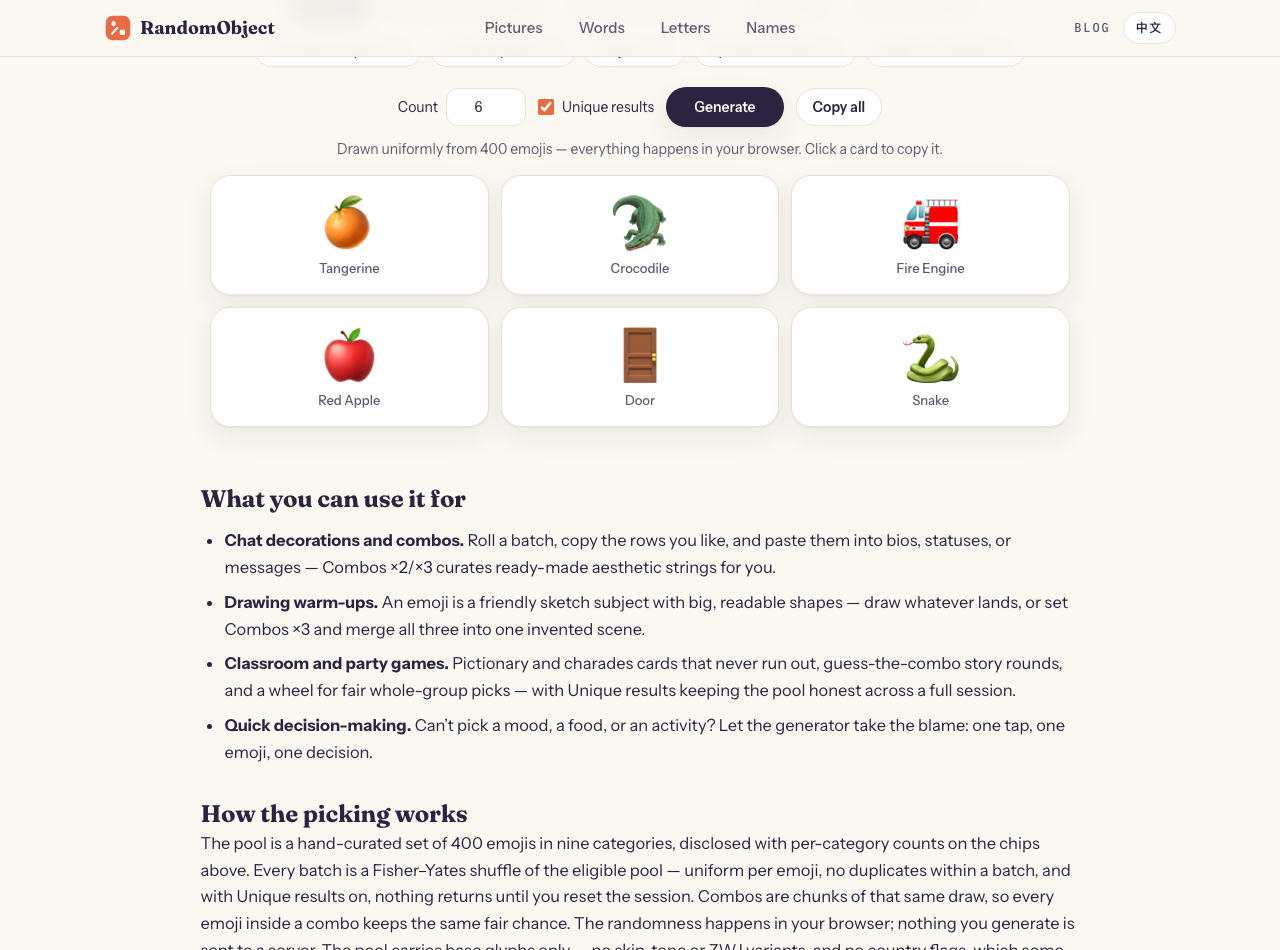
1. Emoji movie and song guesses
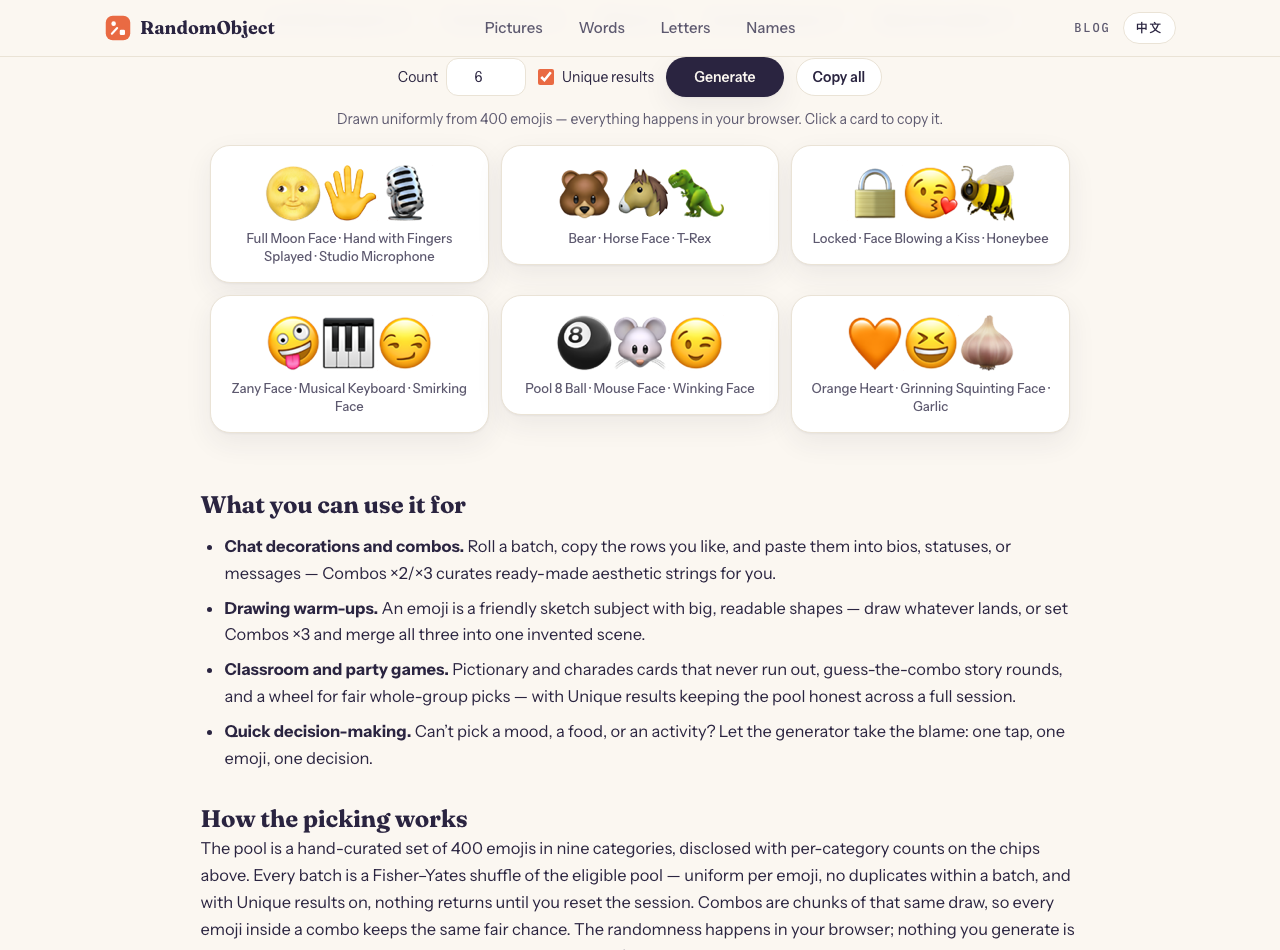
Draw a ×3 combo and invent a movie, song, or book title it could encode — then let the room guess your title from the combo. 🐻🐴🦖 might be Jurassic Park meets Paddington; 🔒😚🐝 is someone's romantic heist comedy waiting to be named. Rounds alternate: one player announces the combo, guesses fly, the funniest correct-ish answer scores.
- Best for: parties and family nights — no board, no prep, phones optional.
- Rule that keeps it moving: thirty seconds per combo, then reveal and rotate.
2. Rebus sentences — guess the sentence
Combos ×3 are ready-made rebus puzzles. Read the three emoji as a sentence and guess what it says: 🎙️✋🌕 could be "speak up, stop, wait for the full moon" — or whatever grammar the guesser can defend. Teams take turns authoring combos and decoding each other's; the author decides which decoding "counts."
- Best for: classroom brain-breaks and ESL warm-ups — decoding forces full-sentence production, not single words.
3. Draw it — guess from a sketch
Reveal one emoji to one player, who must draw it (or draw the ×3 combo as one scene) while the room guesses. Emoji are forgiving sketch subjects — big shapes, no perspective — which makes this the gentlest version of Pictionary for mixed drawing skills. The pool has a food-and-drinks category of 60, so snack-themed rounds can run for hours.
- Best for: family game night and art-class warm-ups; the drawing drill from the emoji page doubles as practice between rounds.
4. Emoji telephone
Classic telephone with a glyph twist: player one secretly views a combo, whispers their interpretation down the line ("bear, horse, dinosaur… some kind of zoo escape?"), and the last player guesses the original combo. The comedy lives in how interpretations drift — combos ×3 drift fastest.
- Best for: groups of 5–10; works standing up, which makes it the right game for the last ten minutes of a class.
5. Story chain — one emoji per link
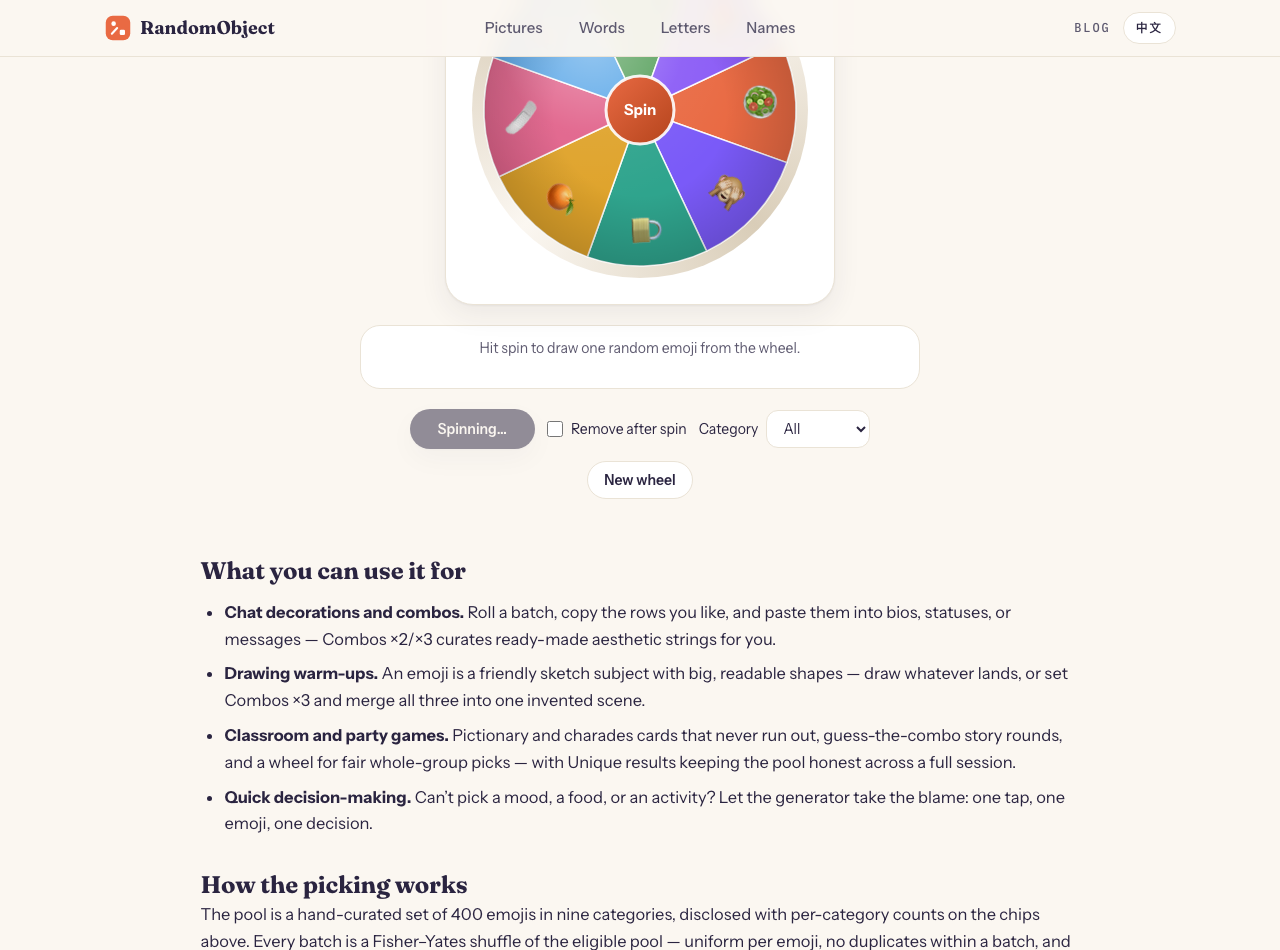
Draw a single emoji; the first player starts a one-sentence story featuring it. Each subsequent player draws a new emoji and folds it into the story as one sentence. The wheel gives whole-group picks a fair, visible spin. After ten links, retell the whole story from memory — the retelling is the real game.
- Best for: writing warm-ups and campfire circles; pairs naturally with the random-word method from creative writing.
Generator settings for guessing games
- Combos ×2 or ×3: the puzzle material — ×2 for quick rounds, ×3 for movie and rebus games.
- Unique results: on, so a session never re-serves the same emoji to the same room.
- The wheel: one fair, visible pick for "who goes next" or the final showdown emoji.
Common Questions
Do we need accounts or apps? No — the generator runs in the browser with no sign-up, and every pick copies with one click if you want to paste combos into your own slides or chat.
Can young kids play? Yes — games 3 and 5 work for early readers, and the pool is hand-curated: base emoji only, no skin-tone or ZWJ variants, no country flags, so every glyph renders the same on every device.
What if someone has seen the combo before? Generate again — with 400 glyphs and ×3 combos, the space is effectively endless for one session, and Unique results keeps the room honest.
The Point
Guess-the-emoji needs exactly two things: glyphs nobody predicted, and someone willing to guess out loud. The generator supplies the first part; the room has always had the second.
Related reading
- Flip-card classroom games — the photograph-based sibling set
- Classroom games with random objects — object-drawing game variants
- Random food ideas — when the food category needs a snack break